Introduction
As Las Cruces real estate professionals, we understand that the history of Las Cruces New Mexico is more than just dates and events. It’s the foundation of the community we know today.
From Indigenous settlements and Spanish explorers to the arrival of the railroad and the rise of modern innovation, each chapter of the history of Las Cruces explains why families are drawn here, why the culture feels so unique, and why the housing market continues to thrive.
Below, we trace the city’s journey from ancient footsteps to space-age milestones and show how those stories shape life and real estate in Las Cruces today.
Why the History of Las Cruces Still Shapes Life Today
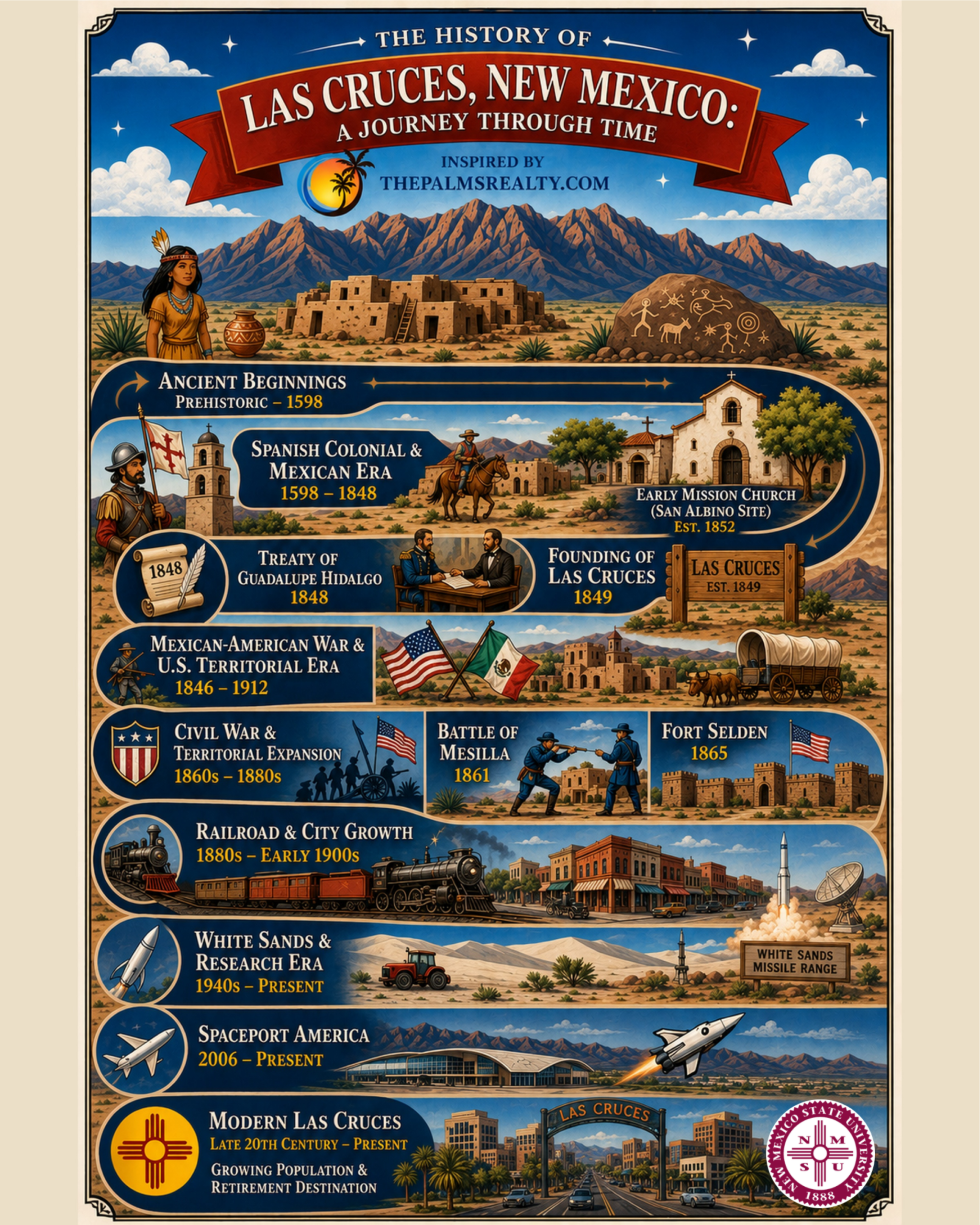
1 Deep Indigenous Roots – People on the Land for 23,000 Years
 Did you know human history in the Mesilla Valley predates recorded time?
In 2021 archaeologists discovered fossilized footprints in the gypsum flats of White Sands National Park, just east of Las Cruces, proving humans have lived here for roughly 23,000 years, a cornerstone in the history of Las Cruces New Mexico.
These footprints confirm that present-day Indigenous communities descend from those early residents, extending far beyond the previously accepted 13,500–16,000 year timeline.
The valley’s earliest permanent settlers were of the Mogollón culture (c. 1280–1300), whose descendants include the Manso people, the Piro‑Manso‑Tiwa tribe and other Indigenous groups living here today.
Their pueblos, irrigation systems and trade routes laid the foundation for future settlements. Recognizing these roots is vital: much of our local architecture, place names and cultural festivals still reflect Manso, Apache, Jano and other Indigenous traditions, a living thread in the history of Las Cruces.
Key Takeaways
-
- Ancient footprints: Evidence of human activity in White Sands dates back 23,000 years.
-
- Mogollón and Manso heritage: The Mogollón people are ancestors of the Manso and Piro‑Manso‑Tiwa tribes.
-
- Ongoing traditions: Modern communities still honor these lineages through annual feast days and pilgrimage ceremonies in Tortugas and other villages.
2 Spanish Exploration and the Royal Road
Why do so many street names sound Spanish? Because Spain’s influence here began more than four centuries ago. In 1598 Juan de Oñate led colonists north from Mexico City along El Camino Real de Tierra Adentro—the 1,500‑mile Royal Road linking Mexico to Santa Fe.
Oñate’s expedition not only established Spain’s northern frontier but also introduced European farming techniques, religion and architecture to the Mesilla Valley.
The Spanish crown’s Laws of the Indies established urban planning guidelines centered on a plaza, church and government buildings, patterns still visible in nearby Mesilla.
This colonial period also saw the construction of missions like Nuestra Señora de Guadalupe and the arrival of Manso, Tiwa and Apache peoples who traded, intermarried and sometimes resisted Spanish rule.
The 1680 Pueblo Revolt briefly expelled Spanish settlers from northern New Mexico, forcing many south to El Paso and slowing European colonization in the valley and shaping the history of Las Cruces for generations.
3 Mexican Independence and the Mesilla Valley
After Mexico gained independence from Spain in 1821, trade restrictions loosened.
Mexican colonists founded the Doña Ana Bend Colony in 1843, completing the first irrigation canal (acequia madre) before planting season.
The region remained contested; during the Mexican–American War, a skirmish known as the Battle of El Bracito occurred near Las Cruces on Christmas Day 1846.
The 1848 Treaty of Guadalupe Hidalgo ended the war and ceded the Mesilla Valley to the United States. This shift opened the floodgates for American settlers heading west.
Mexican loyalties lingered, however. Nearby Mesilla, established in 1850, became the county seat and remained the cultural center for decades.
4 U.S. Survey and Founding – The Birth of Las Cruces (1849)
The settlement we now call Las Cruces emerged directly from American expansion, a pivotal point in the history of Las Cruces New Mexico.
In 1849 Lt. Delos Bennett Sackett of the U.S. Army surveyed the Mesilla Valley, plotting 84 city blocks each containing four lots.
Residents drew for their parcels in a sort of lottery, and the grid design influences our downtown street pattern today.
Origin of the Name
Where did the name “Las Cruces” come from?
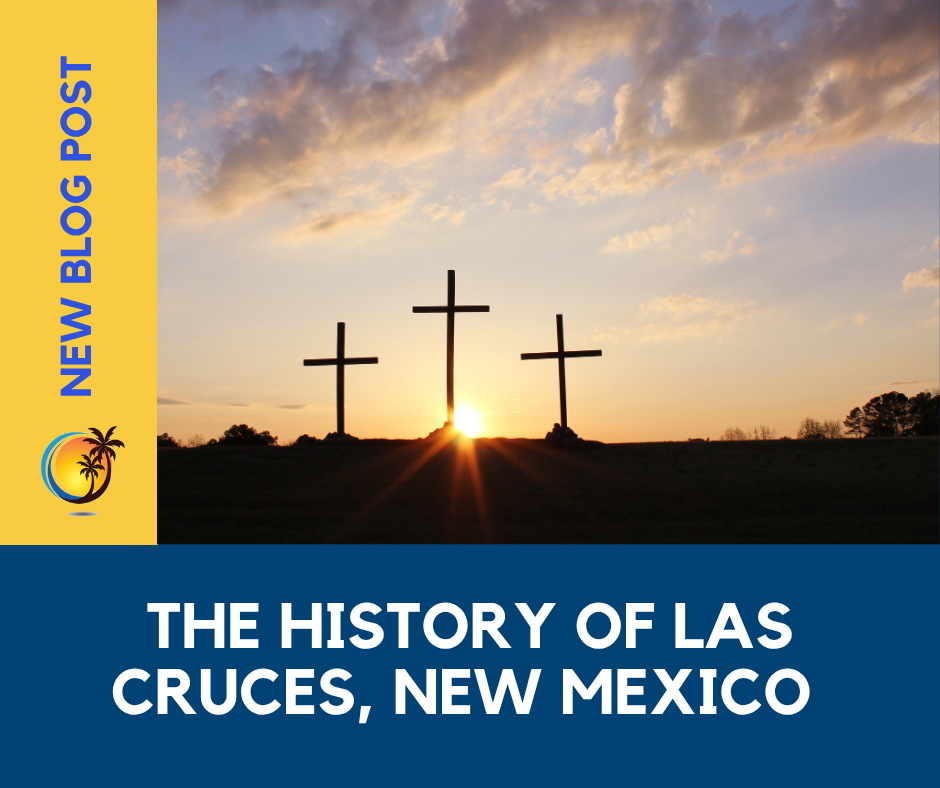
While several legends exist, most historians agree it derives from the Spanish “las cruces,” meaning “the crosses.” Early settlers reported seeing three crosses north of the town—either grave markers or descansos (roadside memorials)—which inspired the town’s name and became part of the enduring history of Las Cruces.
The name highlights the area’s heritage as both a crossroads of cultures and a resting place for travelers.
Gadsden Purchase and Boundary Changes
In 1854 the Gadsden Purchase resolved lingering border disputes between the U.S. and Mexico, transferring 29,670 square miles of land (including southern New Mexico and Arizona) to the United States. This purchase allowed for a southern transcontinental railroad and secured Las Cruces’s place in U.S. territory.
Mesilla’s residents initially had more wealth and influence; yet when railroad developers sought rights‑of‑way, Mesilla landowners refused.
Las Cruces businessmen, eager for progress, donated land for a depot, ensuring the railroad—and economic growth—came to their town instead.
5 Railroads, Education and Early Prosperity (1880s–1912)
 Arrival of the Atchison, Topeka & Santa Fe Railroad
 Arrival of the Atchison, Topeka & Santa Fe Railroad
The first train reached Las Cruces in April 1881. Though not a major junction, the railroad connected our agricultural community to national markets, leading to growth from roughly 2,300 residents in the 1880s to almost 3,000 by 1900.
The station, now preserved as the Las Cruces Railroad Museum, sits west of downtown near the Alameda Historic District—home to Victorian and Southwest revival architecture that remain icons of the history of Las Cruces New Mexico.
Founding of New Mexico State University
In 1888 the New Mexico College of Agriculture & Mechanic Arts opened in Las Cruces. Its first class of five graduated in 1893. Today the institution, known as New Mexico State University (NMSU), remains central to our economy and cultural life.
Incorporation and Early Infrastructure
Las Cruces was officially incorporated as a town in 1907.
By the time New Mexico achieved statehood in 1912, the town boasted a water system, electric power, an ice factory, cold‑storage facilities, a cannery and even a steam laundry.
Land sold for just $25 to $50 per acre, and the population hovered around 4,000 in the 1920s.
These early civic investments show the community’s ambition and set the stage for later urban renewal.
6 Challenges and Transformation (1920s–1960s)
Agriculture and the Elephant Butte Dam
Agriculture thrived because of the Rio Grande’s irrigation potential. The construction of Elephant Butte Dam upstream helped regulate flows, allowing Mesilla Valley farmers to cultivate cotton, chile and pecans.
During the Great Depression, crop prices plummeted and many farms struggled, but New Deal programs provided relief.
World War II and White Sands Proving Ground
The Second World War had profound local impacts. More than 2,000 New Mexicans died in the conflict, many from southern New Mexico.
Labor shortages led to the Emergency Farm Labor Program, which brought over 900 German and Italian POWs to the region to work farms.
In 1945 the U.S. Army established the White Sands Proving Ground (later White Sands Missile Range) just east of Las Cruces. Weapon testing and rocket development at White Sands would shape local employment and attract scientific talent.
By 1963 the White Sands Test Facility was also built, providing high‑paying government jobs and stimulating population growth, and marking a new era in the history of Las Cruces New Mexico.
Urban Renewal
Las Cruces undertook an ambitious urban renewal project in the 1960s, seeking to modernize the downtown core. St. Genevieve’s Catholic Church (1859) was razed to build a pedestrian mall.
Covered walkways later gave way to a more traditional main street design. Today’s Downtown Revitalization Project continues this work, combining historic preservation with new commercial and residential developments.
7 Modern Growth – Space Age to the 21st Century
A Hub for Aerospace and Space Tourism
Las Cruces sits at the nexus of space exploration. Spaceport America, 55 miles north, is the world’s first purpose‑built commercial spaceport.
The city is home to Virgin Galactic’s corporate headquarters and serves as a staging area for civilian suborbital flights. These enterprises, along with NMSU’s aerospace engineering programs and NASA’s test facilities, diversify our economy and attract high‑tech professionals, continuing the evolving history of Las Cruces New Mexico.
Retirees, Culture and Quality of Life
Since the 1990s the city has welcomed waves of retirees drawn by our mild climate (over 320 days of sunshine per year), affordable housing and cultural amenities.
The city frequently appears on “best places to live” lists thanks to its arts scene, outdoor recreation in the Organ Mountains – Desert Peaks National Monument, and community festivals such as the Las Cruces Farmers & Crafts Market and Hatch Chile Festival.
Population and Economy Today
From a settlement of 84 plots, Las Cruces has grown to over 95,000 residents.
Major employers include White Sands Missile Range, NMSU, healthcare providers, manufacturing firms and the hospitality sector.
Housing remains comparatively affordable, with median home values around $293,000 (data from 2025).
Las Cruces is part of the Borderplex, a tri‑state region with El Paso, Texas and Ciudad Juárez, Mexico that fosters cross‑border business and cultural exchange.
8 Historic Neighborhoods and Landmarks – A Realtor’s Perspective
Understanding local history enhances our ability to guide clients. Here are some key districts and sites every buyer should know:
-
- Mesquite Historic District: East of Main Street, this area features adobe houses built by Hispanic families and offers a rustic charm. It sits along El Camino Real and provides a window into 19th‑century life.
-
- Alameda Historic District: Developed after the railroad arrived, this neighborhood includes Victorian and Southwest revival homes and is anchored by Pioneer Park. It appeals to buyers seeking character and proximity to downtown.
-
- Downtown and Railroad Museum: The restored 1881 depot and adjacent plaza host events and farmers markets, and new mixed‑use projects blend historic facades with modern living.
-
- Mesilla Plaza: Just south of Las Cruces, Mesilla retains its 19th‑century adobe buildings and hosts festivals, art galleries and the famous Double Eagle Restaurant (rumored to be haunted). Its charming plaza and boutique shops attract both residents and tourists.
As realtors at The Palms Realty, we emphasize that each neighborhood tells a story, from the cross‑cultural roots of Mesquite to the railroad‑era elegance of Alameda.
Buyers interested in historic homes should consider the preservation requirements and potential tax incentives available for properties listed on the National Register of Historic Places.
9 Conclusion – Honoring the Past, Investing in the Future
The history of Las Cruces New Mexico is a narrative of resilience, diversity and opportunity. From ancient footprints to the space age, each chapter adds richness to our community.
As real estate professionals, we know that a home here isn’t just four walls—it’s a piece of a continuing story.
Whether you’re captivated by the adobe homes along El Camino Real or excited by the innovation at Spaceport America, Las Cruces offers a lifestyle rooted in history and open to the future.
10 Why is the history of Las Cruces New Mexico relevant to homebuyers?
Understanding our history helps buyers appreciate the cultural layers that shape neighborhoods. Heritage conservation programs can affect remodeling, while proximity to historic districts may enhance property values. It also fosters a sense of place—knowing you’re living where Indigenous peoples farmed, Spanish colonists traveled or railroad pioneers built homes enriches the homeowner experience.
11 What’s the difference between Mesilla and Las Cruces?
Mesilla was the dominant settlement after the Mexican–American War, with over 2,000 residents in 1860. When the railroad bypassed Mesilla, development shifted to Las Cruces. Today Mesilla retains its historical atmosphere, while Las Cruces is the larger city and commercial hub.
12 Did the Gadsden Purchase impact Las Cruces?
Yes. The Gadsden Purchase of 1854 resolved border disputes and provided land for a southern rail route. Without it, Las Cruces might have remained under Mexican jurisdiction and developed very differently.
13 How did World War II change the city?
The war caused labor shortages and personal loss—over 2,000 New Mexicans died. It also led to the Emergency Farm Labor Program, bringing German and Italian POWs to local farms. Additionally, the establishment of White Sands Proving Ground and later White Sands Missile Range provided high‑skill jobs and spurred population growth.
14 How has Las Cruces’ long Indigenous history shaped today’s community, and can I find homes near cultural landmarks?
Las Cruces honors its Native heritage through cultural centers and preserved sites. You’ll find homes near these landmarks in areas that blend tradition with modern living.
15 Where can I see Spanish colonial architecture in Las Cruces, and what historic properties are for sale there?
Spanish colonial style is most visible in Mesilla and parts of the Mesquite Historic District. Properties occasionally come on the market here, and a local realtor can guide you.
16 How did El Camino Real influence Las Cruces real estate, and which districts still carry that legacy?
The El Camino Real trade route shaped early settlement patterns. Today, Mesilla and Old Mesquite carry that historic legacy, offering unique housing opportunities.
17 Who can show me homes near historic mission sites in Las Cruces that capture this Spanish heritage?
A knowledgeable Las Cruces realtor can connect you with homes near mission-style churches and heritage districts, blending history with everyday convenience.
18 How does Mexican independence history influence property styles in Las Cruces, and where should I look?
You’ll see adobe homes and Spanish-influenced layouts in Mesilla and older neighborhoods. These areas showcase charm tied directly to Mexican independence history.
19 I want a home in one of the original 84 blocks — how can I find one with a realtor who knows this history?
Partner with a local expert familiar with downtown Las Cruces’ historic grid. They’ll know where to find available homes in the city’s original layout.
20 What’s the story behind the name “Las Cruces,” and can I live near the landmark crosses?
“Las Cruces” means “the crosses,” a reference to early memorial markers. Homes near the Organ Mountains offer views of these iconic landmarks.
21 How did the railroad boom shape Las Cruces neighborhoods, and which areas still reflect that charm?
The railroad spurred growth downtown and along Alameda. Historic districts still showcase the charm of homes built during that expansion.
22 Are there neighborhoods affected by urban renewal where I could invest with the help of a realtor?
Yes, parts of central Las Cruces were reshaped mid-20th century. A realtor can point out areas with revitalization potential for smart investments.
23 What impact did White Sands Missile Range have on local real estate, and who can help me find homes near there?
White Sands drew families and jobs, fueling housing growth. A local broker can help you find homes convenient to both the range and Las Cruces.
24 Why is Las Cruces popular among retirees and tech professionals, and how does that affect home availability?
With sunny weather, affordability, and proximity to Spaceport America, demand is steady. This creates competitive opportunities best navigated with a realtor.
25 Where can I find historic adobe homes in Las Cruces, and are there preservation requirements?
Adobe homes are common in Mesilla and Mesquite. Some require preservation care, which a knowledgeable agent can help you understand.
26 Is living near Mesilla Plaza a good investment, and who specializes in properties there?
Yes! Mesilla Plaza offers cultural charm and strong demand. Work with a local realtor specializing in Mesilla to secure opportunities.
27 Who can connect me with homes that honor history while offering modern comforts in Las Cruces?
We at The Palms Realty specializes in guiding buyers to properties that balance historic character with today’s conveniences.
28 How did Elephant Butte Dam shape the history of Las Cruces New Mexico?
The completion of Elephant Butte Dam in 1916 provided reliable irrigation to the Mesilla Valley. This turned the region into one of the most productive agricultural hubs in the Southwest, making pecans and chile central to the economy and identity of Las Cruces.
29 Did World War II impact the history of Las Cruces New Mexico?
Yes. During World War II, over 900 German and Italian POWs worked on local farms to address labor shortages. This unusual chapter in the history of Las Cruces New Mexico shows how global conflicts influenced local growth and reshaped the workforce.
30 What role did NASA play in the history of Las Cruces New Mexico?
In the 1960s, NASA began testing spacecraft at the White Sands Test Facility just outside the city. This milestone in the history of Las Cruces New Mexico established the area as a hub for aerospace innovation and continues to attract scientists and engineers.

Ready to Make Las Cruces Your Home?
The history of Las Cruces New Mexico shows us why this city continues to thrive, and why so many families are proud to call it home. Whether you’re looking to buy, sell, or explore your options, our team at The Palms Realty is here to guide you every step of the way.
📞 Call Today: 575-621-5780
Or simply fill out the form below, and we’ll be in touch to help you start your Las Cruces real estate journey.